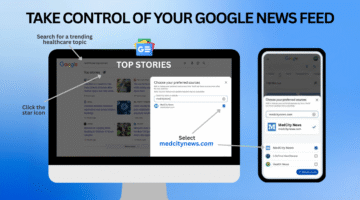
Take Control of Your Healthcare News: Add MedCity News to Your Google Preferred Sources
Make us a preferred source to get incisive news and analysis on healthcare and life science companies when you need it.
Make us a preferred source to get incisive news and analysis on healthcare and life science companies when you need it.

As healthcare continues to become more decentralized, enabling patients to be successful with their therapies at home isn’t just a “nice to have,” it’s a “must have.”

Small practices play a critical role in healthcare delivery, but they cannot continue to absorb ever-increasing administrative demands without consequences.
May has seen a slew of executive hires, exits and layoffs across the healthcare industry. For example, the American Medical Association and TigerConnect named new CEOs, and Google and UnitedHealth Group have seen key executives leave their roles. There were also layoffs at organizations including Devoted Health and New York-Presbyterian.

While Google showcases AI's ability to mimic human sentimentality, it misses the forest for the trees. The real innovation, the true potential of AI, lies not in replacing human expression but in enhancing human lives, particularly those of our rapidly aging population.
During a session at CES 2024, a Google exec shared several changes the company has made through YouTube to protect children and teens.

Google introduced a new suite of healthcare-focused generative AI models designed to speed up workflows for clinicians and medical researchers. Health systems and medical research organizations, including HCA Healthcare and BenchSci, have been testing these models since April.


Healthcare payments are no longer about transactions. It’s about controlling the revenue cycle. And increasingly, that control is not sitting with ISOs.

There are several ways to know if a digital mental health solution is working, including whether it has proven clinical outcomes or if it's improving access to care, executives said during a panel discussion.

A new study led by Stanford researchers tested four commercially available LLMs and found that they all could potentially cause harm by breeding inaccurate, racist information. For example, all models tried to justify race-based medicine when asked questions about calculating patients’ kidney function and lung capacity — two areas where race-based medicine practices used to be common but have since been scientifically refuted.

The federal government has warned hospitals that using third-party analytics tools on their websites could violate HIPAA, and more than 20 hospitals are facing class-action lawsuits over the use of these tools. But a recent analysis found that hospitals are doing a poor job of fixing their websites and preventing patient data collection.
Senator Mark Warner (D-Virginia) penned a letter to Google leadership expressing concerns about Med-PaLM 2 — the company’s generative AI tool for healthcare providers that is currently being used by Mayo Clinic and other health systems. The letter requested that Google provide more clarity about its chatbot’s training, accuracy, ethical considerations and deployment in healthcare settings.

Enterprise EHR boosts scalability, interoperability, and governance for large healthcare systems.

Three senators recently introduced legislation that would ban the use of health data for advertising and marketing purposes. The proposed legislation comes amid media reports claiming that data brokers are selling social media companies patients' location data, as well as reports that hospitals and digital health startups are collecting patients’ online data and sharing it with tech giants such as Facebook and Google.

GoodRx failed to notify users that it sold their personal health information to Google, Facebook and other tech companies, the FTC claimed. The agency filed an order that prohibits GoodRx from sharing its users' data with third parties for advertising purposes and requires the company to pay a $1.5 million penalty. GoodRx agreed to pay the settlement but did not admit to wrongdoing.

Medical device manufacturer iCAD entered into a development and commercialization agreement with Google Health, in which it will integrate Google’s mammography AI technology into its suite of breast imaging AI products. The agreement marks Google’s first commercial partnership to deploy its breast imaging AI model into clinical practice.

Uncertainty, benefits navigation, cost and innovation are some of the key challenges ahead for those in the employee health benefits space. Executives made these comments last week during the HLTH conference in Las Vegas.

A panel of healthcare data experts recently broke down some of healthcare’s most common buzzwords at HLTH. While the experts agreed that many industry professionals still struggle to grasp the true denotations of words and phrases like “interoperability” and “reimagining healthcare,” the panelists said these terms can be quite meaningful once they’re unpacked.